The Minesweeper Subset Rule
When every unknown cell in one clue group also appears in a larger clue group, subtract the smaller group’s cells and remaining mine count. The difference can force a safe cell or a mine.
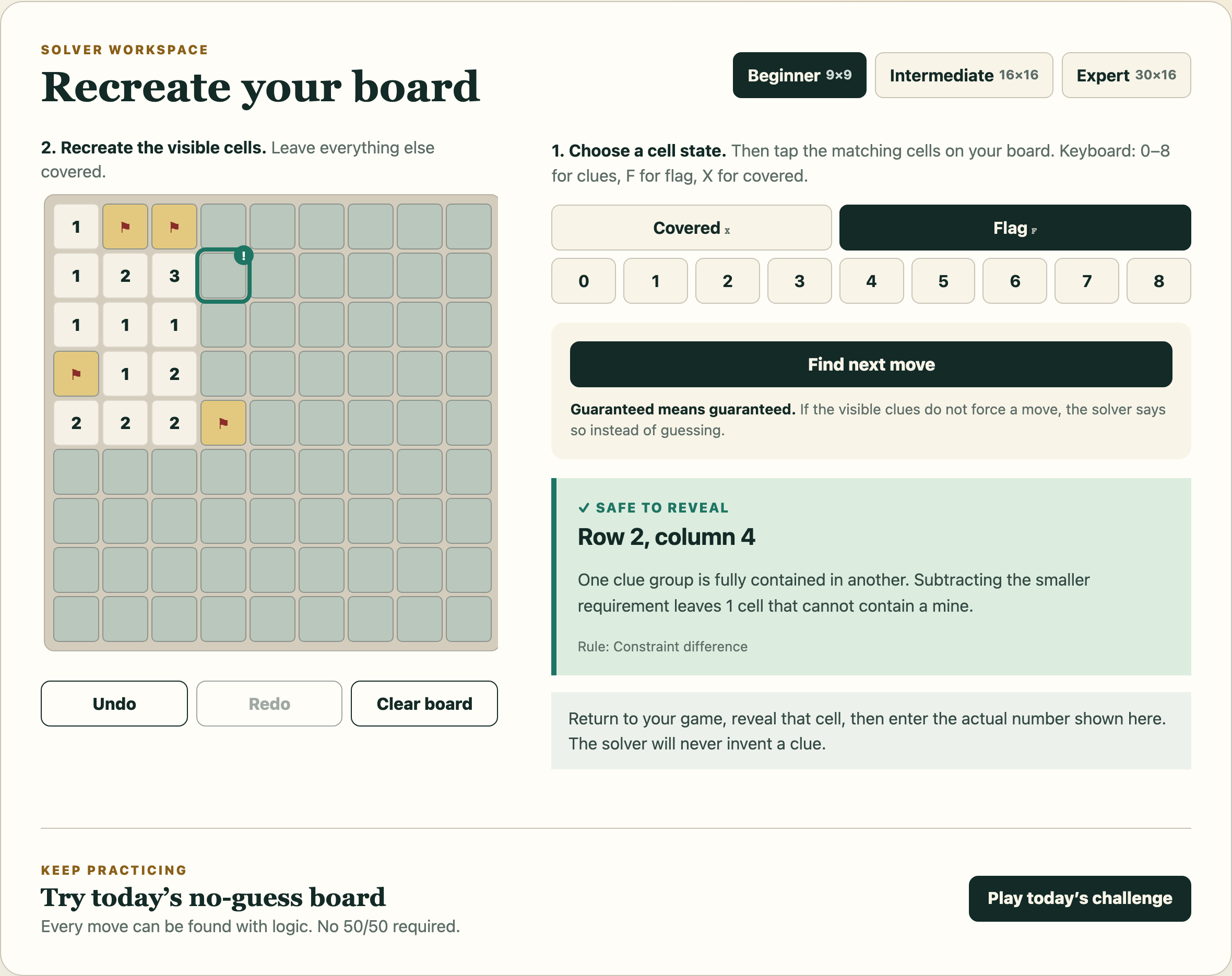
Subtract two overlapping clue groups
- The 1 below the 3 covers three unknown cells.
Exactly one mine is somewhere among the three covered cells running down the right side of that clue.
- The 2 below it already touches one flag.
Its two remaining covered neighbors therefore contain exactly one mine.
- Those two cells are contained in the first group.
Both groups require one mine. Subtracting the two-cell group leaves the extra cell—row 2, column 4—with zero mines. It is safe.
The difference may be safe or mined
Difference requires 0 mines
Every cell left after subtraction is safe. That is the result in this example.
Difference requires every cell
If the remaining mine count equals the number of remaining cells, all of them are mines.
Derive 1-2-1 and 1-2-2-1 instead of memorizing them
These familiar sequences are not separate solver rules. They are compact applications of constraint subtraction when the clues sit along a straight boundary and the listed covered cells are the complete unknown sets for those clues.
1-2-1: outer mines, middle safe
Call the three covered cells A, B, C. The clues give A + B = 1, A + B + C = 2, and B + C = 1. Subtraction forces A = 1, B = 0, and C = 1.
1-2-2-1: inner mines, outer safe
Call the four covered cells A, B, C, D. Comparing the contained clue groups forces B = 1 and C = 1. Therefore A = 0 and D = 0.