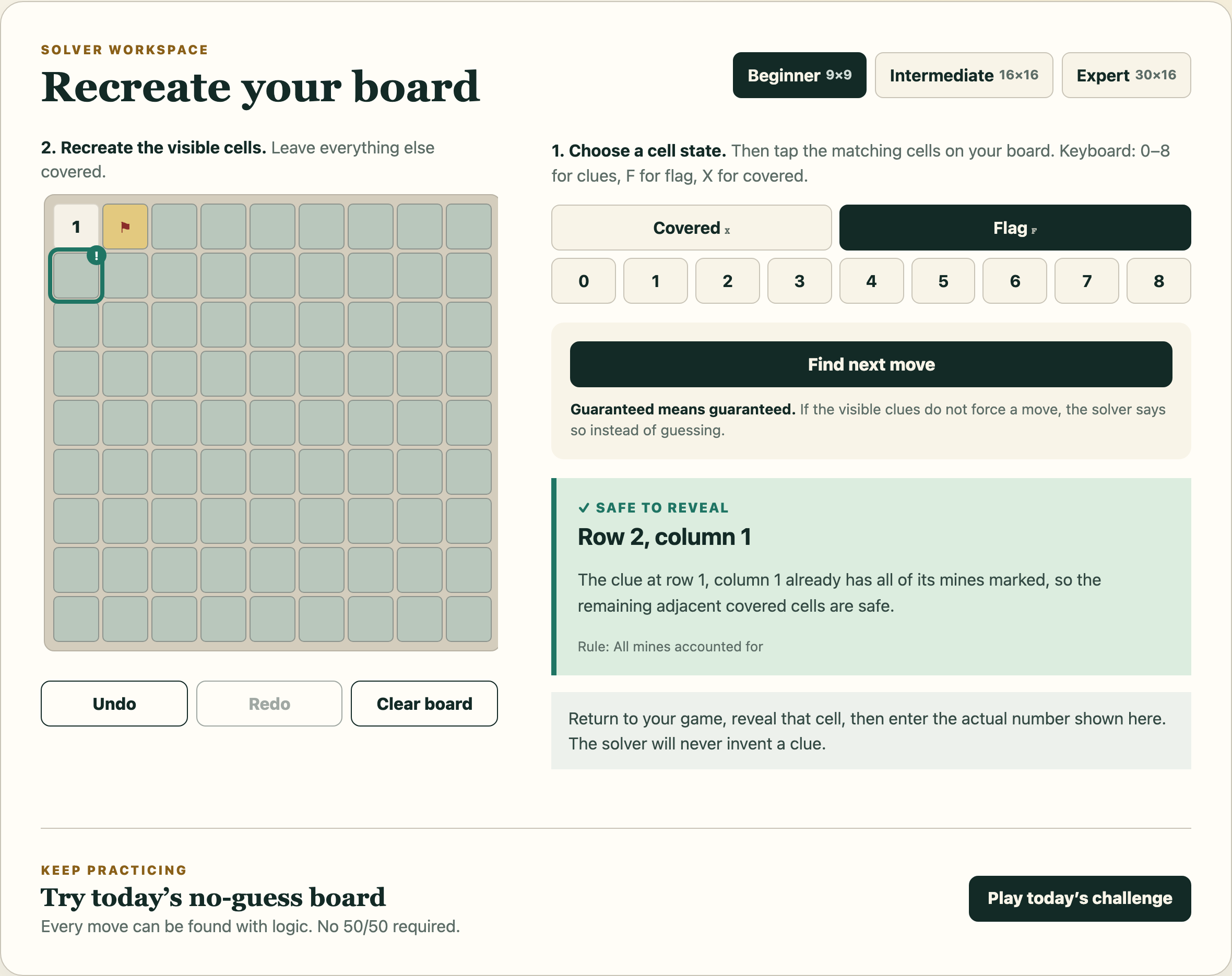
All Mines Accounted For
When a clue already touches its full number of marked mines, every other adjacent covered cell is safe.
See the proof →These are the same rules the local solver uses. Each guide starts with a forced conclusion, then shows the exact clue arithmetic and a board you can reproduce yourself.
Check your own boardLearn the direct rules first. Use subset subtraction when no single clue is enough.
When a clue already touches its full number of marked mines, every other adjacent covered cell is safe.
See the proof →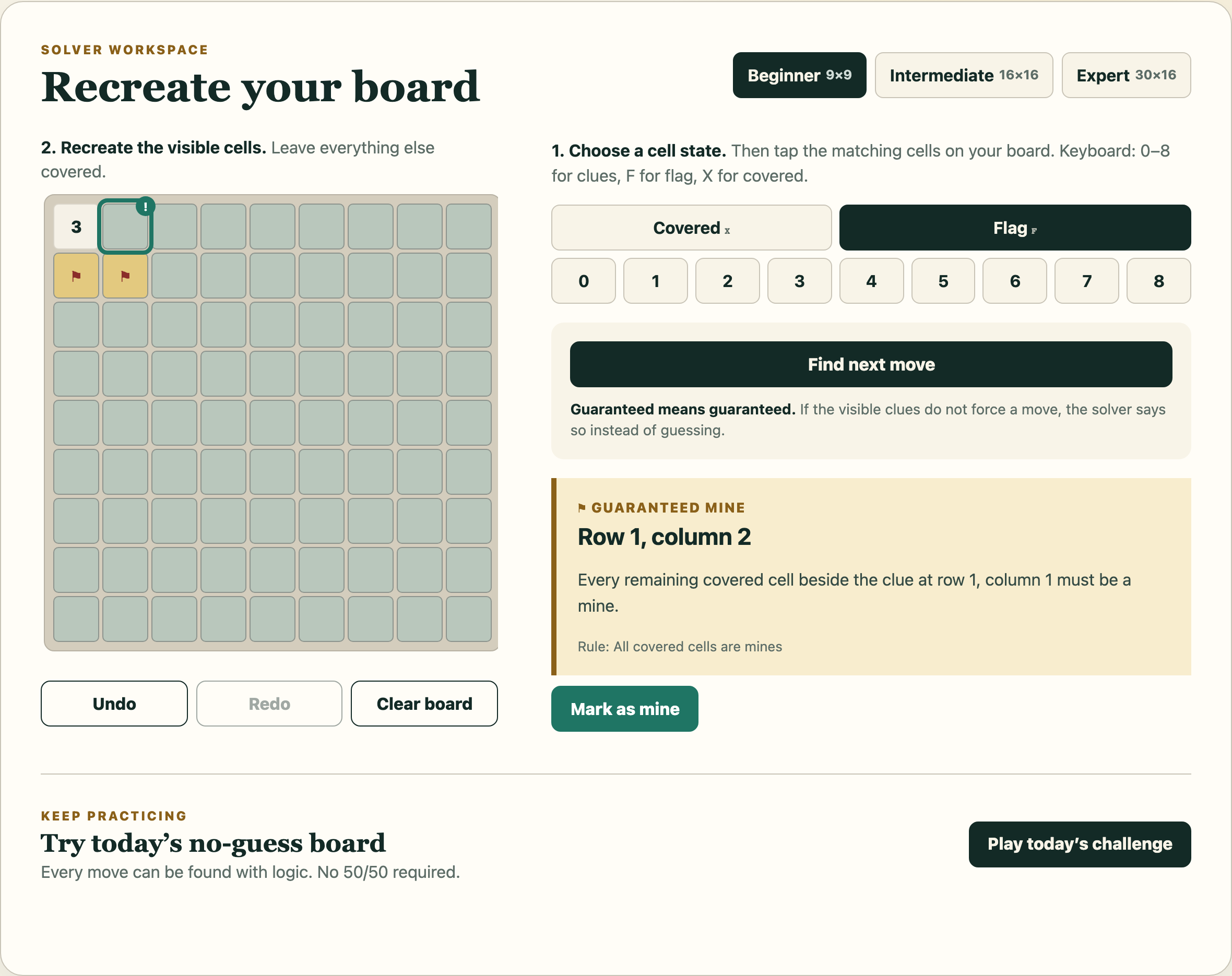
When the mines still required equal the remaining covered cells, all of those cells must be mines.
See the proof →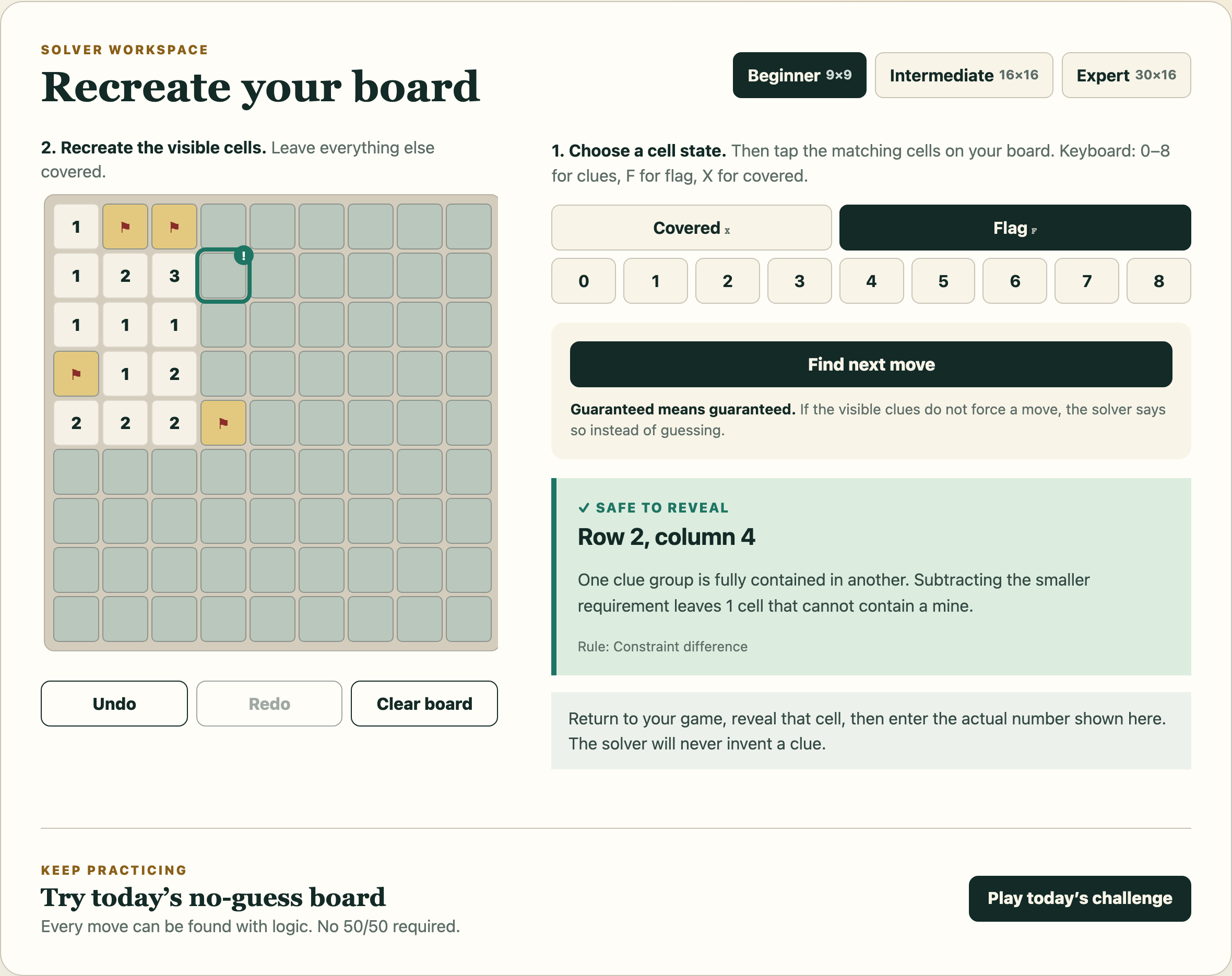
When one clue group sits completely inside another, subtract the smaller constraint to isolate a safe cell or mine.
See the proof →Sequences such as 1-2-1 and 1-2-2-1 are memorable edge cases of the same constraint-difference rule. They are useful only when the covered-cell geometry matches the pattern and any existing flags have already been subtracted.
In a valid straight-edge 1-2-1, the two outer covered cells are mines and the middle cell is safe. In a valid 1-2-2-1, the two inner covered cells are mines and the two outer cells are safe.
See the equations and the conditions that make these deductions valid →
A 2×2 group can feel like a guess when the clues sit on different sides. Treat it as a tiny constraint problem instead: list the few mine layouts that satisfy every surrounding clue, then keep only the cells that have the same state in every layout.
For example, two diagonal mines may be forced when one clue requires three mines around the box and a neighboring clue requires one. The conclusion comes from the shared counts, not from the shape of the digits. If more than one layout survives with different states for a cell, the position is still ambiguous.
Minesweeper Coach currently reports only guaranteed moves from direct counts and contained-constraint subtraction. Use the Solver to check those proofs; do not treat a box pattern as a probability claim.
Start with the clue arithmetic, not the digit shape. The result is guaranteed only when the listed covered cells are the complete unknown group for that clue.
| Rule or sequence | Required condition | Guaranteed result | Check before using it |
|---|---|---|---|
| All mines accounted for | clue − flags = 0 | Every other covered neighbor is safe. | Every flag beside the clue must be correct. |
| All covered cells are mines | Remaining mines equal remaining covered neighbors. | Every covered neighbor is a mine. | Count only cells adjacent to that clue. |
| Subset rule | One unknown-cell set is completely contained in another. | Subtract the groups; the difference may be all safe or all mines. | Overlap alone is not enough: containment is required. |
| 1-2-1 | Straight boundary with exactly three covered cells beside the clues. | Outer cells are mines; the middle cell is safe. | Corners or extra covered neighbors invalidate the shortcut. |
| 1-2-2-1 | Straight boundary with exactly four covered cells beside the clues. | Inner cells are mines; outer cells are safe. | Subtract existing flags before matching the sequence. |
The screenshots come from the working Minesweeper Coach interface, with each board manually recreated and solved locally.
If the visible constraints do not force a move, the solver reports that no guaranteed move was found.
Community discussions can establish provenance. The board recreation, proof, limitations, and screenshot are our original work.